
2014 So Far

The Czech Republic finally formed a government, with Bohuslav Sobotka as Prime Minister and Andrej Babis as his deputy. Mr Babis is also the Minister of Finance, a position he insisted on in-order to create this coalition government. His impressive CV in business, which has led him to become one of the countries richest men and best entrepreneurs, leads many to believe he is the right man to improve the country’s financial situation.

Positive figures have been abundant in press releases from the government, with household income (+3%), GDP (+2.5%), industry and building figures all up. The Czech National Bank will hold interest rates at 0.05% for the foreseeable future. It will also continue fixing the Czech Koruna close to the 27Kc/EUR mark into 2015. Both aspects of the Bank’s policy are helping with the improved economic situation.

Unemployment levels has remained low in most of the country, but the far east remains worst effected.

The Czech Government’s stance on Russia’s actions in Ukraine has been very supportive. They are offering full support to their fellow former Soviet state and will welcome any refugees effected.
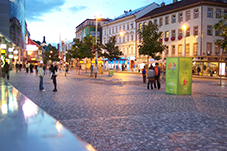
 

Prague Districts Part 4 – Prague 5

Praha,_Smíchov,_křižovatka_Anděl


Prague 5 lies to the south-west of the centre. It borders Prague 1 to the North-East running South-West to the city border. The vast borough is home to some very wealthy suburbs, some beautiful landscapes and a bustling commercial centre. After the fall of communism the borough was earmarked for redevelopment and gentrification.

The Metro station Andel was formerly known as Moskva, a throwback to its former Russian overlords. The area around this station, which included a disused railway station has been fully transformed to a centre of commerce, shopping and dining. The introduction of Novy Smichov shopping centre and several thousands of square meters of class A office space has helped the upper area of Smichov build a new image.

Further out of town, along the river there is the Staropramen factory, one of Prague’s key brands and exported products. Inland is an array of small would-be towns between hills. One such hill also houses a key component of Prague’s rich tapestry – the Barrandov Film Studios. The studio has worked with many of Hollywood’s greats and was started by the father of Vaclav Havel, the first prime minister of Czech Republic.

Like most areas of Prague there are many new developments, both residential and commercial, with many more scheduled to finish in the coming years. It is a well connected borough, with tram lines and the metro running to its extremities. To the far south-west lies the furthest metro station, Zlicin, which has become a popular area. It is a main interchange for transport coming into Prague from the west, housing huge shopping parks and increasing numbers of residential developments. It is also a quick bus ride away from the airport.

Being such a large and diverse borough it is necessary to isolate specific areas for recommendation. Andel is a perfect area for investment, but residential property is sparse. A few stops away from that area and the difference in development is very noticeable. Until now these areas have been not well liked, but that is changing as the gentrification spreads. This surrounding area can be a solid investment. Other areas on the Metro, like Zlicin, can also be good areas to look at, but watch out for some areas dominated by communist-era panel buildings.


Czech Republic voted 2nd best place to invest in CEE

Czech Republic has overtaken Poland and Hungary in Site Selection‘s top list and awarded the silver medal. The US magazine ranks a large number of countries, including Russia and Turkey in this section.

A key factor was the number of investment projects, both new and existing projects where expansion is taking place. A lot of thanks can be given to CzechInvest, the ministry agency, for its work on creating the projects and continually finding investors.

“After fDiIntellingence magazine named the Pardubice region the most attractive region in Eastern Europe for investors in March, the Czech Republic has again received significant recognition. Second place is an outstanding sign that we have something to offer investors,” Ondřej Votruba, acting CEO of CzechInvest, said in a press release.

New Investment Opportunities

Our latest offer is Beroun Hills. 10% deposit paid, 90% finance and a 7% yield guaranteed for 3 years. A great package for any investor.

Low unemployment, population growth and fantastic nature mean the city of Beroun is one of the most sought after in Czech Republic and is only 30mins from Prague. Prices have risen by 18% locally in the last 12 months – the fastest growing area in the country.

We have a limited number of units available (just 9 at the time of writing). These units have become available because of changes in existing client situations.

Those with employment income are easiest to meet the criteria of the mortgaging bank. Other sources of  income can be acceptable.

The maximum mortgage term is 30 years, although is limited by the buyers 67th birthday. For those able to get a mortgage of over 23 years this will create a monthly profit. For those who cannot, there will be a small amount to pay each month – but with 10% free equity and a guaranteed rent this deal makes a lot of sense.

For more information contact us on +420 736 535 556 or info@investmentsolutions.cz

Prague Districts Part 3 – Prague 4

Prague 4 covers the south of the city, to the east of the Vltava. The area is very large and one of great natural beauty – it’s hilly and naturally forested in most parts. Historically, therefore it has been quite rural, but with the advent of the metro system it has become the modern business area of Prague. Pankrac, Budejovicka and Chodov are all now bustling business areas bringing in commuters from all over Prague. Bank headquarters and local offices of worldwide brands stand side-by-side: Raiffiesen, Ceska Sporitelna, IBM, DHL, Microsoft, Novartis to name but a few.

This influx of office buildings and workers has lead to a transformation of the residential real estate market. Modern living is well sort after locally, but many don’t mind the commute from the centre – just 10-15mins by metro. We see the demand for local, quality housing rising in this area and further out of Prague. One of the most controversial developments in the area has to be Kavci Hory:

But at 100.000CZK/m2 when first advertised, it showed that their was potentially the demand for expensive housing. Historically housing had been cheap locally, especially in the panel houses beyond Chodov, heading East and into Prague 10.

We think Prague 4 is a good location for investors looking for higher-end property – there is certainly demand and local wealth to afford it.


Accountancy Season Open

Thankfully one area of law relatively unaffected by the upheaval of the Czech Civil Code is individual tax returns. We’re offering our existing clients the usual special offer – 2.500Kc regardless of number of properties.

Just contact info@investmentsolutions.cz to get your order in today. We complete accounts in an average of just one week from receiving your documents.

2013 Round-Up

Despite a lack of government, there has been no lack of optimism in Czech Republic. GDP for Q4 is thought to be positive. Property prices have risen for a second consecutive year. Interest rates have remained low.

The Czech National Bank’s intervention in exchange rates has staved off deflation and increased exports. It is also to expect to bring a new wave of foreign investment, with the CZK 10-15% better value than last year

A new Czech coalition government has assumed office after being sworn in by President Miloš Zeman at Prague Castle. The centre-left cabinet, formed by the Social Democrats, ANO and the Christian Democrats, came to power 95 days after the general election, promising to ease austerity, boost economic growth, and return the country to the EU mainstream.

2013 in statistics:

Prices didn’t increase like we thought but overall ALL prices across Czech Republic increased by 1%

Volume of mortgages (includes refinancing) increased 28% worth 155 billion CZK…blowing away the 2007 record

Volume of new mortgages increased 18% creating additional wealth for many Czechs

Interest rates hit their lowest in July but still remain near all time lows

Top mortgages were for 3 bedroom flats in Prague and large village houses exceeding 120m2

Developers sold a record amount of newly completed flats in 2013 – 5015 – with over 1500 being sold in Q4 alone. Record numbers and 1/4th of those purchases were for investment purposes

Over 6700 new flats are currently on the market though only 35% have been completed. The number was closer to 10,000 2 years showing that supply is shrinking quickly

3 consecutive quarters of increasing prices across the country


Prague Districts Part 2 – Prague 3 and 10

London has its East End, New York has its Brooklyn. Prague has its Zizkov.

Zizkov occupies almost the entire of the Prague 3 boundary. The area directly East of Prague 1 and 2, bordering both. Traditionally a working class neighbourhood, but also with a rich artistic history, it houses several significant sights. During the later 20th Century the area was relatively poor and declined. Many buildings were in poor condition, some derelict – a strange sight given the area is on the borders of wealthy areas.

Move forward to 2013 and things are very much on the rise. The area is popular with expatriates, foreign students and locals alike. The Prague University of Economics, the Reigrov Park and the square of Jiri of Podebrad are all key to creating a vibrant, cosmopolitan atmosphere. Gentrification of the area has been ongoing and some areas have seen house prices rise significantly in recent years. The attraction for investors are the below average buy prices and above average rents – as well as the further growth in prices expected. 40.000CZK/m2 for buying is not uncommon, as is 250CZK/m2 for rentals. This is fuelled by higher than average turnovers from a younger population.

Bordering Zizkov to the South and Prague 2 to the South-East is Vrsovice. Vrsovice occupies the western part of Prague 10. The borough is a mixture of industrial and working-class residential areas. It too has a major University, housing one of Charles University’s Faculties of Medicine at the Vinohrady Hospital. Following on from the rise of Zizkov, Vrsovice is developing it’s own identity and is increasingly popular with students. House prices and rents are in-line with the best Zizkov can offer investors, but with more abundance. The only negative here is the distance from the historic centre: Zizkov is only 1km away, as opposed to Vrsovice at 3km away. It’s not a huge distance, but there is that old investor’s saying: Location, location, location.

Election 2013 – Results and Analysis

The Czech Republic still doesn’t have a government since the collapse of the Petr Necas’s scandal ridden reign. The centre-left party, the Czech Social Democrats picked up 21% of the vote, whilst the centre party ANO picked up 17% and the Communists picked up 15%.

ANO was a surprise result. It is a new party headed by a Slovak-born billionaire and was languishing in early opinion polls. The Communist vote was also somewhat surprising, but most votes came in poor areas with high unemployment and low prospects – easy to see why they may feel communism might be worth another try.

In order to create a government, the social democrats will need to bring on board ANO and one other party. The problem is that ANO do not agree with the policies laid out by the social democrats – namely tax increases. Any deal would swing on the head of ANO being the finance minister – something which is rumbling along, but likely to be agreed in the near future.

To make matters worse, the social democrats also have a leadership battle. The current leader is being asked to resign by many in the party as they did not gain the 30% vote he had promised to bring. Many are backing the leader of the Moravian section to lead the whole party and a coup could be immenent, even though he swore allegiance to the current leader days before the election. It’s never dull with Czech politics.

So what does it all mean for the markets and economy? In a nutshell, right now the economic growth is the main factor, but if instability in government remains it will start to overshadow this. This will mean falling markets and general bad news for investors. Hopefully common ground can be found and things can move forward.

Czech National Bank Devalues Koruna to Stave Off Deflation

In a surprise move on November 7th, the Czech National Bank (CNB) intervened with the foreign exchange in order to devalue the Koruna (CZK) against the euro (€). The move sent the CZK tumbling against the euro some 4.4% The CNB will continue to intervene in order to keep the exchange rate at 27CZK/euro.

The decision to devalue was based largely on weaker inflationary figures. Inflation slowed to 0.7% in October across the euro zone, well below the 2% target. The euro zone as a whole as well as the Czech Republic climbed out of a long recessionary period in Q2 of this year. However economic data has slowed dramatically in Q3 forcing central banks to seriously worry about deflation.

Deflation remains the economic world’s ultimate nightmare which falling prices weaken demand and slow credit, leading to wage cuts and even lower prices. The CNB reported that without the intervention the Czech economy would suffer at least 3 quarters of deflation to begin 2014.

The CNB hopes the deflationary measures will promote further growth in exports, which have been running at a surplus for 2013. However the government’s austerity measures over the past 3 years have all but stalled consumer spending and curbed economic growth. An issue ISG refers to frequently.

80% of the Czech Republic’s GDP derives from exports including cars, electronics, coal and minerals.

With deflation no longer an issue, the CNB is gambling that the economy can now finally grow.

ISG remains cautiously optimistic. However, deflation is certainly a word no property owner wants to hear. Investors can now breathe easy knowing their property values will not decrease and new, foreign investors may actually have an unique buying opportunity.