Plans for Redevelopment on Hold at Derelict Freight Station

Prague’s ‘Nakladovy Nadrazi’ in Zizkov was abandoned over 10 years ago. The prime site, close to the development Central Park and just a stone’s through is prime land. It is one of the largest areas for redevelopment for its proximity to the centre. Sekyra, developer of our sales project Rezidence Korunni has been trying to turn this site into a modern multi-functional space for a decade. Plans include grade-A office buildings, a shopping centre, residential developments and even a new metro station. Essentially they would produce a modern living and working environment for 15.000 people.

Last week the local council decided to enter into another study for the site after protests from conservationists. They argue the site is of historical importance and more work should be done to conserve existing structures in the redevelopment, rather than flattening it. Sekyra’s architects argue that much work would need to be done to use the existing structures, built nearly 80 years ago, in order to be altered. They suggest grants from the city would be needed in order to do this. Many other architects argue that the structures have little historical importance. They comment that better examples are already preserved in Prague.

This debate looks to rumble on for a little longer, but it is clear that redevelopment will happen in some guise soon, which excellent news for those who have invested in the area or plan to soon.

The full article posted by Prague Post is available here.

New Development Sets Prices at 2007 Levels

One of the Czech Republic’s largest developers has announced a new development phase in central Prague. The developer is due to set pricing levels similar to those seen in 2007, at an estimated 45.000Kc/m2 if bought off-plan. This compares favourably to the current average of 55.000Kc/m2 in the area right now, which is still depressed.

Not only is the development planned to be low cost, it is also planned to be good quality. Based on current rental prices, we would expect yields to be over 6.5%, with capital growth of 20% by completion.

Combined with other news in the local area about potential redevelopment, including a Metro this looks like a smart move by the developer to generate fast sales. Sales of several developments have been slow with plenty of vacant stock still around. This has been due to developers’ insistence on achieving decent profits, which are dictated by their investors.

Developers breaking ground now have the advantage of reduced building costs and larger developers with multiple projects have the option of varying their approaches. Finally property investors are seeing the real fruits of a recession in the Czech Republic.


August Newsletter – Czech Property: 2012 so far….

The Olympics have come and gone and the summer holiday season is quickly drawing to a close.  We, at ISG, hope the summer has been enjoyable and eventful and are looking forward to the second half of 2012.  For now, we would like to provide an update and bold predictions on the Prague real estate market.

Two quarters into 2012 and it appears we have a lead on the future of Czech real estate.  Prague market prices seems to have hit rock bottom in Q4 2011.  Prague prices rebounded slightly in Q1 2012 before falling back minutely in Q2.  It appears the bottom has leveled off and the worse is over.

Currently the market is over saturated with supply.  We believe this will keep Prague prices at their low levels for some time.  However, local demand surprised us in Q1 with local banks reporting a record number of mortgage applications and a 22% increase in mortgage volume year-on-year.  Demand has again increased in Q2.  Mortgage figures have yet to be released but the number of listed flats has increased while the overall supply has remained unchanged.

Supply Shrinking?

The Czech Statistical Office’s (CSU) Q2 figures show a substantial decrease in building permit applications and an astonishing 43% drop in construction of new, multi-dwelling buildings.  An increased demand and shrinking supply should lead to a rise in market prices.  As always however, out-dated, prefabricated flats continue to drive down overall market figures.  The rising demand and trend is for newly built or newly reconstructed flats.  Some areas in Prague have already begun to see much higher increases in prices.  In time, the increased demand and shrinking supply of modern flats will show vividly in the overall market price.

As we reported earlier, the Czech economy remains heavily reliant upon its Eurozone neighbors and especially Germany.  Rising exports once again have driven the Czech economy but Czech citizens turned stingy in Q2 and, in turn, slowed the economy.  GDP fell 0.2% while the economy shrank 1.2%  At this stage economists believe much of the depressed household consumption can be partially blamed to negative news in the media.  The growing economies of the Czech Republic’s trading partners suggest the mild recession is just that, mild.

http://www.hypotecnibanka.cz/o-bance/pro-media/tiskove-zpravy/item:761/

http://www.hypotecnibanka.cz/o-bance/pro-media/tiskove-zpravy/item:759/

http://www.csas.cz/static_bydleni/cs/Obecne_informace/Bydleni/Ceny_nemovitosti/Prilohy/Index_nem_cervenec_2012.pdf

http://www.radio.cz/en/section/curraffrs/czech-economy-contracts-for-third-consecutive-quarter

http://www.czso.cz/csu/csu.nsf/enginformace/csta080612.doc

Karlin Group Launches 4th Residential Project

Karlin Group have launched their 4th residential project in 8 years. The developers of the highly successful Kollarova 14, River Diamond and Cornlofts are back with there latest offering, River Gardens.

The Karlin Group are based in Karlin the area of Prague 8 bordering the centre, Prague 1. The company owns the vast majority of the land in the district, which was famously flooded in 2002. The floods left many parts destroyed and it is the blank canvas that remained that the Karlin Group saw as a fantastic opportunity for redevelopment. Indeed there is no other place so close to the city centre with so much undeveloped land.

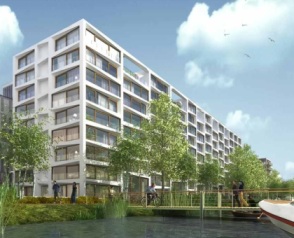
With the fist phase of the commercial part of River Gardens recently completed, albeit by a different developer, it is the perfect time to start the new residential phase. The apartments will be finished to the same luxury standards as their other projects. The unique feature of the project will be its location and disposition, situated between the river and the commercial section. The long building will mean every flat has a view of the river or the sculptured gardens that will separate it from the commercial section. The usually less-desirable, north facing units will in this case be the most desirable because of their river views.

At ISG we are very excited about the project and have been able to negotiate some outstanding off-plan buy prices with the developer. The current offer is 77.000 Kc/m2 (3092 EUR / 2417 GBP). This includes VAT,garage space and cellar) and represents prices unseen since 2007 on a project of this quality. For more information, see our dedicated River Gardens page.

Prague Cheapest for Electricity in CR

Since the government allowed competition in the electricity market, prices have been falling. Aktualne reported this week that competition has been most effective in Prague with the company Elimon 11% cheaper than the state-run PRE.

Falling electricity prices is always welcome news for landlords in CR. Rents generally include electricity here so a reduction in cost essentially means more rent for the landlord. Of course that does mean that landlords would need to move company to take advantage of lower prices. For large flats and houses, especially those with electric heating, such a saving is well worth trying to take advantage of.

Prague City Sells Off 4,000 Properties

Prague councillors have voted in favour of selling off nearly 4,000 properties. This would raise 4Billion CZK of much needed revenue for the City. The money will stay in the property sector and is likely to be spent on specialist housing for the elderly and disabled.

Over 1/3 are apartments in Hlubocepy (Prague 5) with most others in Cerny Most (Prague 9), Stodulky (Prague 5) and Chodov (Prague 4). All of these areas are on the very outskirts of the city. The majority of the apartments were built in the ’80s and ’90s.

The impact on the real estate market locally should not be that great. It is thought the majority of the buyers will be the existing tenants. Buyers will be able to only buy the houses under shared-ownership. They would then be able to apply to change the ownership to fully private. This requires a majority vote of other shared-owners and naturally takes time, hence why there should not be noticeable changes in the market.


Ours Offers Defy The Deloitte Study – June Newsletter

A recent Deloitte study, published on May 24th, has resulted in a wave of misconstrued headlines.  The results try to portray Prague has one of the most expensive European cities for real estate investment calling Prague “the most expensive city in Central Europe in 2011.”  But as we dissect Deloitte’s study we learn “expensive” is not an accurate term.  First, the facts of the study:

– The study consisted of only 12 EU countries: UK, Portugal, Spain, France, Germany, Austria, Netherlands, Denmark, Czech Republic, Slovakia, Hungary and Poland.

– The study only took newly built dwellings into account.  Therefore, newly reconstructed dwellings are not part of this study.

– The minimum dwelling size equated to 70m2.

– The study compared the calendar year 2010 to the calendar year 2011.

– Based on these facts the study showed the average price per square metre was 74.000Kc (£2333/€2895)

Firstly, we don’t think 74.000Kc/m2 is anywhere near accurate. We would say 55.000Kc (£1750/€2150) is a better estimate. The problem with this data is it is based on just new developments in 2011, not actual sales data.

The attention grabbing statement says “a multiple of 2.4 of the average annual gross income is needed to buy a new dwelling in Denmark, it stands at 9.1 in France.  In the Czech Republic, similarly to the Netherlands and Great Britain, more than seven annual gross salaries are needed to buy a new dwelling.”

While this may sound large keep two things in mind: first, the average salary in the Czech Republic is roughly €1000/month according to the Czech Statistical Office and secondly, only newly constructed dwellings have been included in the research.  This new study simply points out what we already know: a middle and upper middle class has emerged and grown in the Czech Republic and especially Prague.

Prague residents enjoy higher average salaries and unemployment is less than 4% compared to the country’s 8.2% rate (Czech Ministry of Labour and Social Affairs).  Czech’s no longer want to be piled into a prefabricated panel housing structure and developers are now meeting the demand.  We do feel, however, that newly completed projects are generally ambitiously priced and we expect these prices to come back.

On a whole, the Prague market is a buyer’s market.  As we’ve pointed out in previous segments, the supply of flats continues to grow as newly built and newly reconstructed projects become complete.  And for the time being, many Czech residents are nervous about the future and unwilling to make large purchases.  The growing supply and weakening demand begs the question, why wouldn’t you buy?

So what is a good investment for the Prague middle classes? We have just got an exclusive discount on rental-ready flats in a quality, central development, starting at just 55.000Kc (£1750/€2150) per square meter:

-23% Reductions Plus Exclusive 10% Discount

-Located In Prestigious Vinohrady, Prague

-Extremely High Quality

-Rental Ready

-High Capital Appreciation Expected

-Excellent Rental Yields For Area

–Click Here For More Information

Also coming soon – similar specification units available off plan starting at just 48.000Kc/m2 very close by. Unbelievable investment opportunity. For more information and to sign up for updates email us on info@investmentsolutions.cz



Czechs need as many salaries as Brits and Dutch to buy property

Deloitte has written a new report on European real estate. It shows the position of the Czech Republic in various statistics.

According to the report an average Czech needs an average of 7 gross annual salaries to afford a flat in the Czech Republic. This is similar to the Brits in Britain or the Dutch in Holland.

This is based on an average price per square meter of €2.500, comparing with the top end of Paris (€8.000) and the bottom end of Budapest (€940). Clearly Prague is still pretty cheap in comparison to Western Europe. However the average price in Prague is more than twice that of the rest of the Czech Republic.

Prague still appears to be the place to be in the Czech Republic. This is no surprise given the low unemployment and higher average wages. It is safe to say though that the wages are not double those of the rest of the country.

We have to ask how accurate are these statistics? Well, they are only based on new constructions in 2011 that were over 70m2 in size. We know there were very few low-end projects finished last year in Prague, thus skewing the numbers somewhat. We also think that Prague has far more reconstructions going on than most cities due to the lack of space in the city for new buildings. Finally, we know that 70m2 misses off at least 50% of normal flats. The average studio is around 30m2 and the average one bedroom flat around 55m2.

What do we make of the report then? We certainly think the report shows that there is a wealthier middle class emerging in Prague that want the finer things in life. With a lot of expats returning home Czech’s have been taking these higher paid jobs and want to live the higher lifestyle. It is still also clear that there is a lot of catching up still to do to Western Europe – which can only be a good thing as a reason to invest in this country!

You can read the full Deloitte report here:

http://www.deloitte.com/view/en_CZ/cz/press/press-releases/fd70cbd8f4f77310VgnVCM1000001956f00aRCRD.htm

Suburbia Fails in Central Europe

With the end of communism came fast-paced change across Central Europe. It began to embrace many Western ideals, one of which was the “American Dream” of Suburbia. Ceska Pozice’s latest report tells of how suburbia failed to catch the imagination of the Czech people, as well as other populations across Central Europe.

Many nouveau riche in 90s Czech Republic commissioned large properties in would-be commuter towns of major cities. The truth is nothing much has changed to these towns; no improvements in infrastructure and amenities.

We are in full agreement with the article and we think it is good to point out the dangers in investing in smaller towns within the Czech Republic and beyond. Beyond Prague, Brno and Ostrava it is definitely worth doing as much research as possible before committing. Attractive buy-prices and lots of positive information are normally the key selling points and it is easy to look at other countries, like the UK, as a guide to how things should turn out. Across Central Europe things do work considerably differently and although there are excellent investments available in smaller towns, they are few and far between and come with larger risks.

If you are considering investing in a small town in the Czech Republic please feel free to contact us with any questions you may have.

The full article from Ceska Pozice is here: http://www.ceskapozice.cz/en/news/society/suburbia-central-europe

Understanding Czech Mortgages – May Newsletter

The Czech National Bank voted last week to keep interest rates at the record low of 0.75%. Two of the board actually voted for lower rates. Analysts in the Czech Republic are predicting a further fall in rates in the next 6 months. All this is great news for investors able to take advantage of such decreases. With many investors asking questions about how to get on board with refinancing, we thought a brief guide was in order for this month. It is also the perfect time to launch our “Refinance For Free Offer”….Click here to read more.

Q&A

Q: My fixed rate has expired, am I now on a variable rate?

A: Almost definitely not, Czech banks send letters no later than 30 days before the end of your fixed term. These letters give choices of new fixation periods. If there is no response in the allotted time frame, the bank fixed you on the best rate term they offered. This is generally for 3 years.

Q: Can I refinance at any time?

A: You can, but there are penalties to pay. This means any gains are wiped out by penalties. You should always refinance at the end of your fixed period when the penalty is zero.

Q: How far ahead of time can I refinance?

A: It is possible to organise a mortgage up to 9 months before it is required. It is best to plan well in advance and take advantage of low rates.

Q: How long does the refinancing process takes?

A: A minimum of 6 weeks is required to get the best possible chance of the refinancing happening. There is always a chance of holidays and additional paperwork being needed that could take time beyond 6 weeks. Our advice: start as early as you can.

Q: Can I release equity in my property by taking a mortgage?

A: Yes you can. The Czech’s call this an American Mortgage and rates are higher than normal, at approximately 6% interest.

Q: What is the best possible rate interest right now?

A: 2.9% for a 90% LTV mortgage and 2.5% for a 70% LTV mortgage on variable rates. 3.5% and 3.2% respectively for fixed rates. Our full Q&A has more info on which is better.

Q: As a foreign investor am I guaranteed to get these rates?

A: With Czech banks, you either fit their criteria or you don’t. This means you won’t be penalised by a few percentage points just for being foreign. The only time it may not be possible to get these rates is if the property does not value up (ie LTV over 90%) or the  portfolio is large and the repayments are well beyond the rents.

Q: How much does it cost to refinance?

A: Currently most banks are offering this for free. The associated paperwork normally costs around 6.000Kc, but right now we are offering this for FREE – see here

Q: How do I know what interest rate will put me on next time?

A: You won’t know this answer until 6 weeks before the end of fixation. It depends on payment history. All we know is that banks gamble by giving higher interest rates for re-fixation than they do for new clients. We also know that our rates are the best on the market for foreign clients, so the answer shouldn’t be too much of a concern.

Q: How much difference does a 1% drop in interest rate make?

A: Table showing savings per 1.000.000Kc on a 1% rate decrease on a 25 year mortgage
Repayment at 5.5% Repayment at 4.5% Repayment at 3.5%
Monthly Repayment 6.141 Kc 5.558 Kc 5.006 Kc
Yearly Savings vs 5.5% rate – 6.996 Kc 12.936Kc
10 Yearly Savings vs 5.5% rate – 69.960 Kc 129.360Kc

Remember this is per 1Mkc!

Q: What Effect Does The Interest Rate Have On Capital Repayment?

A: As we know, regardless of the interest rate, you always have to pay back the same amount as you borrowed! What isn’t as clear is that lower rates mean accelerated capital repayment for most of your mortgage, an excellent bonus for any customer who is not going to see the full term. In our chart below we look at a 1.000.000Kc mortgage over 25 years, with 4% and 5% rates. The maximum difference is 30.000Kc, or 3% of the total borrowed. This is a considerable difference and should not be overlooked:

As ever, we at Investment Solutions are on hand to give free, impartial advice to help you make the most out of your investment. Email info@investmentsolutions.cz